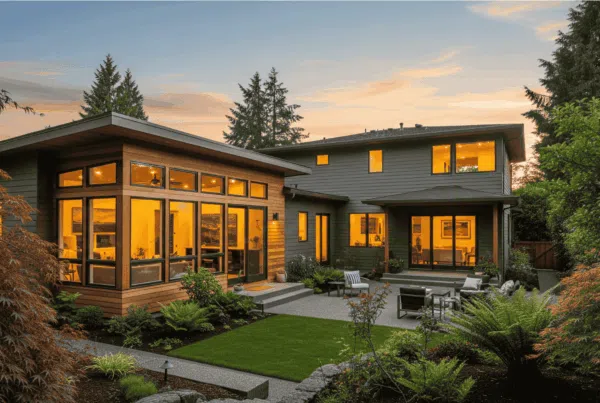
PACIFIC NORTHWEST WINDOW BUYING GUIDE UPDATED 2026
Choosing Replacement Windows for Pacific Northwest Homes: Glass, Frames & Efficiency
Compare glass, NFRC ratings, frame materials, operating styles, installation methods and moisture details before ordering windows for a Kirkland or Pacific Northwest home.
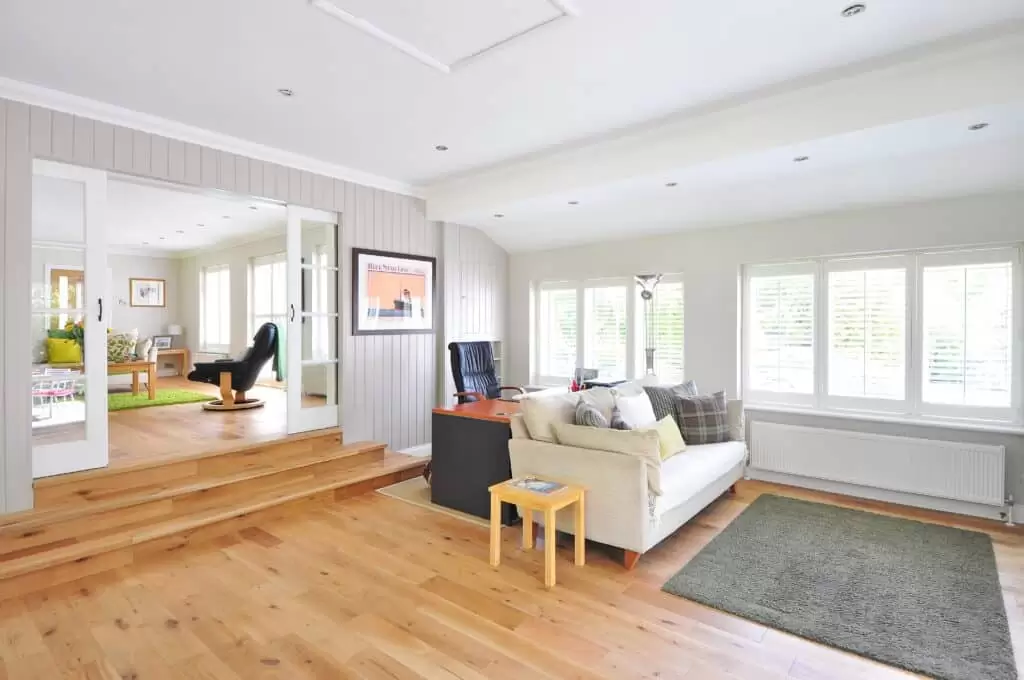
Compare the complete window systemGlass → Frame → Installation
Quick Answer: What Should You Look for in Replacement Windows?
For a Kirkland or Pacific Northwest home, choose replacement windows in this order:
- Identify why the existing windows are failing.
- Decide whether you need insert replacement or full-frame replacement.
- Match the operating style to the room.
- Compare whole-window NFRC ratings—not marketing claims.
- Prioritize an appropriate U-factor.
- Choose SHGC based partly on orientation and solar exposure.
- Select double or triple glazing based on actual performance and goals.
- Choose a frame material based on moisture exposure, architecture and maintenance.
- Make sure flashing and drainage-plane integration are part of the installation strategy.
- Check Kirkland permit, egress, safety-glazing and fall-protection requirements.
The biggest buying mistake is comparing windows like this:
vinyl vs. fiberglass vs. wood
before answering:
What problem are these windows supposed to solve?
A more expensive window is not automatically the correct window.
Replacement Window Buying Checklist
Before ordering windows, you should be able to answer:
- Why are the existing windows being replaced?
- Is there frame rot or water damage?
- Is moisture between the panes?
- Are drafts coming through the window or around the installation?
- Do windows operate safely?
- Is outside noise a concern?
- Do we need more ventilation?
- Do we want more or less glass area?
- Which windows face north, south, east and west?
- Which windows receive strong afternoon sun?
- Are any openings in bedrooms?
- Is safety glazing required?
- Is fall protection relevant?
- Can the existing frames remain?
- Would insert windows reduce too much glass area?
- Does full-frame replacement provide a better opportunity to correct water-management problems?
- What is the NFRC U-factor?
- What is the SHGC?
- What is the visible transmittance?
- What is the air-leakage rating?
- What frame material is being proposed?
- What Low-E coating is being proposed?
- Is the unit double-pane or triple-pane?
- How will the opening be flashed?
- How will the window integrate with the wall’s drainage plane?
- Does Kirkland require a permit for this scope?
If those questions are unanswered, comparing brands is premature.
Replacement Window Comparison at a Glance
| Decision | What Matters Most |
|---|---|
| U-factor | Lower means less heat transfer through the whole window |
| SHGC | Controls how much solar heat enters |
| Visible Transmittance | Indicates how much visible daylight passes through |
| Air Leakage | Lower leakage is generally preferable |
| Double vs. triple pane | Compare whole-window performance, comfort and cost |
| Low-E coating | Helps control radiant heat transfer |
| Vinyl | Moisture resistant, low maintenance |
| Fiberglass | Dimensionally stable, strong thermal potential |
| Wood | Natural appearance, good insulation, more maintenance |
| Clad wood | Wood interior with protected exterior |
| Aluminum | Strong/slim but needs proper thermal-break strategy |
| Insert replacement | Retains sound existing frame |
| Full-frame replacement | Removes old frame and exposes rough opening |
| Installation | Must manage both air and water |
| Permit | Depends on building type and structural alterations |
NFRC provides standardized ratings for whole-window U-factor, SHGC, visible transmittance, air leakage and condensation performance, making its label far more useful for comparing products than vague claims such as “premium glass” or “high efficiency.” (National Fenestration Rating Council)
1. Start by Diagnosing Why the Existing Windows Need Attention
Do not replace windows simply because they are “old.”
Age is context.
Condition is the better starting point.
Look for problems such as:
- rotted frame components;
- broken glass;
- failed insulated-glass seals;
- condensation trapped between panes;
- difficult operation;
- damaged hardware;
- significant drafts;
- water intrusion;
- repeated condensation problems;
- poor comfort near large glass areas.
Then identify whether the problem belongs to:
The Glass
Examples:
- failed insulated-glass unit;
- broken pane;
- poor thermal performance.
The Window Unit
Examples:
- damaged sash;
- frame deterioration;
- failed weatherstripping;
- poor operation.
The Installation
Examples:
- air leaking around the frame;
- poorly integrated flashing;
- water intrusion around the opening.
The Wall
Examples:
- damaged sheathing;
- failed drainage plane;
- exterior-cladding problems.
That distinction matters because replacing the glass will not repair a wall leak.
2. Fog Between Panes Usually Points to an Insulated-Glass Seal Problem
Modern insulated windows typically use two or more panes that are sealed as an insulating glass unit.
When moisture appears between sealed panes, the insulated-glass seal may have failed.
That is different from ordinary condensation on:
- the room-side surface;
- the exterior surface.
Do not diagnose all window condensation the same way.
Better Question
Where exactly is the condensation?
Interior-surface condensation, exterior condensation and moisture trapped between panes have different causes.
3. Decide Whether the Window Actually Needs Full Replacement
Not every window problem requires removing the entire frame.
NFRC’s replacement-window guidance recognizes several approaches, including sash replacement, insert replacement and complete window replacement. (NFRC Consumer Guide to Windows)
The condition of the existing frame should influence the decision.
4. Insert Replacement vs. Full-Frame Replacement
This is one of the most important decisions in the entire project.
Insert Replacement
With an insert replacement, much of the existing window frame remains.
The new unit is installed inside that existing opening.
NFRC identifies insert replacement as potentially appropriate when the existing frame and sill are in good condition and structurally sound. One trade-off is that the new frame sits within the old frame, which can reduce the final glass area. (NFRC Consumer Guide to Windows)
Insert Replacement Can Make Sense When
- the existing frame is sound;
- no significant water damage is present;
- the opening is reasonably square;
- existing interior/exterior finishes should remain;
- preserving the existing frame is desirable.
Full-Frame Replacement
Full-frame replacement removes the existing window frame and exposes the rough opening.
NFRC notes that this can make sense when the existing frame is deteriorated, a larger opening is needed, the frame will not accept an insert, or air/water problems around the existing frame need to be addressed. (NFRC Consumer Guide to Windows)
Full-Frame Replacement Can Make Sense When
- frames have deterioration;
- water damage is suspected around the opening;
- significant out-of-square conditions exist;
- glass area would become too restricted with an insert;
- the opening is changing;
- existing installation defects need correction.
Important Buying Insight
Do not let “replacement window” automatically mean insert window.
Determine what condition you are actually trying to correct.
5. In the Pacific Northwest, Installation Is Part of the Window
A high-performance window installed poorly can still:
- leak air;
- leak water;
- damage surrounding materials;
- perform below expectations.
NFRC specifically states that proper installation is necessary for an airtight fit and continuous water management around replacement windows. (NFRC Consumer Guide to Windows)
That is especially important in a wet climate.
6. Understand the Wall’s Water-Management Strategy
Windows interrupt the exterior wall’s water-control layers.
The U.S. Department of Energy’s Building Science Education resources emphasize that window openings are vulnerable locations and that properly integrated flashing should direct water out of the wall rather than into the wall cavity. (Building Science Education)
That typically means coordinating:
- sill/pan flashing;
- side flashing;
- head flashing;
- water-resistive barrier;
- siding or cladding;
- sealants.
Window Installation Principle
The goal should not be:
“Caulk everything and hope no water ever gets behind the siding.”
A robust wall should also have a strategy for directing incidental water safely outward.
7. Air Sealing and Water Management Are Different Jobs
A window needs both.
Water Management
Prevents or redirects rainwater intrusion.
Air Sealing
Reduces uncontrolled airflow between indoors and outdoors.
DOE building-science guidance specifically notes that gaps between a window unit and rough opening can be substantial air-leakage locations and should be sealed appropriately rather than relying on fibrous insulation alone. (Building Science Education)
Important
Do not assume:
flashing = air seal
or
spray foam = flashing
They address different parts of the enclosure.
8. Learn to Read the NFRC Label Before Comparing Brands
This is one of the strongest ways to improve your window shopping.
NFRC provides independent standardized ratings so homeowners can compare actual window configurations. (National Fenestration Rating Council)
Focus on these values.
WINDOW PERFORMANCE FRAMEWORK
Ratings Beat Marketing Labels
Compare the certified performance of the exact window configuration, then match glass, frame and operating style to the orientation, room and installation method.
9. U-Factor: Start Here for Thermal Performance
U-factor measures how readily heat transfers through the complete window assembly.
Lower is better for reducing heat transfer.
NFRC’s consumer guidance describes a lower U-factor as better at keeping heat from escaping. (National Fenestration Rating Council)
Kirkland Code Context
The City of Kirkland’s current window-replacement guidance states that qualifying new or replacement windows in IRC residential structures must comply with Washington State Energy Code requirements. Prescriptively, it lists a maximum U-factor of 0.30, or an area-weighted average no greater than 0.30 where multiple windows are installed. (Kirkland)
Washington’s current residential energy-code table likewise lists U-0.30 for fenestration in Climate Zone 5 and Marine 4. (Washington State Legislature)
Important Distinction
Code maximum does not mean “best window.”
It is a compliance threshold.
You can compare products with lower U-factors when performance goals justify them.
10. Don’t Shop for Windows Using Center-of-Glass R-Value Alone
Window advertising sometimes highlights impressive glass-only insulating numbers.
But you are buying:
- glass;
- spacers;
- sash;
- frame;
- seals;
as one unit.
That is why whole-window NFRC U-factor is more useful for comparing complete window products. NFRC identifies its certified performance label as the reliable standardized comparison tool. (NFRC Consumer Guide to Windows)
Better Comparison
Product A:
“High-performance triple glass!”
Product B:
“Whole-window NFRC U-factor 0.xx”
The second specification is more useful for an apples-to-apples performance comparison.
11. SHGC: Understand Solar Heat Before Automatically Choosing the Lowest Number
Solar Heat Gain Coefficient (SHGC) measures how much solar heat passes through a window.
Lower numbers admit less solar heat.
Higher numbers admit more.
NFRC describes SHGC on a 0–1 scale. (National Fenestration Rating Council)
But the lowest possible SHGC is not automatically best for every Kirkland window.
Orientation matters.
12. Window Orientation Can Change the Glass Decision
ENERGY STAR specifically recommends considering window orientation when selecting glazing.
Its guidance notes that in colder climates, south-facing windows may benefit from more useful solar gain while maintaining a low U-factor. East- and west-facing windows may benefit from lower SHGC or shading, particularly west-facing windows exposed to afternoon summer sun. North-facing windows receive less direct solar gain, making low U-factor especially important. (ENERGY STAR)
Practical Example
Suppose a Kirkland house has:
North bedroom windows
Primary concern may be:
- heat loss;
- comfort;
- daylight.
West living-room glass
Primary concern may include:
- summer afternoon overheating;
- glare;
- furniture fading.
They do not necessarily need identical glazing specifications merely because they are on the same house.
13. Low-E Glass Is Not One Universal Coating
Low-emissivity coatings are microscopically thin coatings used to manage radiant heat transfer.
DOE notes that Low-E products can be designed for:
- higher solar gain;
- moderate solar gain;
- lower solar gain;
while also influencing visible daylight. (The Department of Energy’s Energy.gov)
Ask More Than
“Does this window have Low-E?”
Ask:
“Which Low-E package is this, and why does it fit this orientation?”
That is a much more useful buying question.
14. Double-Pane vs. Triple-Pane: Don’t Decide by Pane Count Alone
Modern high-performance windows commonly use double or triple insulated glazing. DOE notes that additional glazing layers, Low-E coatings, gas fills and spacer systems can all influence whole-window performance. (The Department of Energy’s Energy.gov)
Triple glazing can provide stronger thermal performance in many configurations.
But the decision should consider:
- whole-window U-factor;
- cost;
- frame;
- window size;
- operating hardware;
- glass weight;
- comfort goals;
- sound-control goals;
- product line.
Better Question
Do not ask:
“Is triple pane always worth it?”
Ask:
“How much does this exact triple-pane configuration improve the whole-window performance compared with the double-pane option?”
Then compare that improvement against cost and homeowner priorities.
15. Argon and Krypton Are Only Part of the Glass Package
Insulated-glass units can use gases such as:
- argon;
- krypton;
between panes to reduce heat transfer.
DOE identifies argon as commonly used and krypton as another insulating gas option. (The Department of Energy’s Energy.gov)
But do not buy a window because a salesperson says:
“It has argon.”
Performance also depends on:
- pane configuration;
- Low-E coating;
- spacer;
- frame;
- sash;
- sealing.
Again, compare the complete NFRC rating.
16. Visible Transmittance Matters in the Pacific Northwest
Visible Transmittance (VT) measures how much visible daylight the complete window allows through.
Higher values allow more visible light.
NFRC includes VT on its label specifically so homeowners can compare daylight performance. (National Fenestration Rating Council)
This can matter when replacing windows in rooms where preserving natural light is important.
Avoid This Mistake
Do not improve one performance metric without asking what happens to:
- daylight;
- glass appearance;
- room character.
The ideal window balances several goals.
17. Air Leakage Matters for Comfort
Air Leakage measures air passing through the window assembly under standardized test conditions.
NFRC includes air-leakage ratings in its residential performance program. (National Fenestration Rating Council)
But remember:
A highly rated window can still feel drafty if air leaks around the installed frame.
This creates two questions:
- How airtight is the window product?
- How airtight is the installation around it?
Do not confuse them.
18. Condensation Resistance Is Useful—but It Doesn’t Guarantee Condensation Will Never Occur
NFRC’s condensation metric describes how well a product resists condensation under standardized conditions; higher values indicate greater resistance. (National Fenestration Rating Council)
Actual condensation in a home can still depend on:
- indoor humidity;
- outdoor temperature;
- interior air circulation;
- curtains/blinds;
- glass temperature;
- window performance.
Important
A window label can tell you about the product.
It cannot control every humidity condition inside the house.
19. Compare Vinyl Windows Based on the Actual Product—not Just “Vinyl”
Vinyl frames have several practical characteristics.
DOE notes that vinyl:
- does not require painting;
- has good moisture resistance;
- can include insulated cavities that improve thermal performance. (The Department of Energy’s Energy.gov)
That makes vinyl relevant for many Pacific Northwest homes.
But all vinyl windows are not equivalent.
Compare:
- frame construction;
- reinforcement;
- sash design;
- hardware;
- weatherstripping;
- glass package;
- NFRC rating;
- exterior color options;
- warranty.
Best Fit
Vinyl deserves strong consideration when homeowners prioritize:
- lower routine maintenance;
- moisture resistance;
- thermal performance;
- budget discipline.
20. Fiberglass Windows: Compare Performance, Not Marketing Superlatives
Fiberglass frames are often marketed as automatically superior to everything else.
The more useful approach is to understand what they offer.
DOE notes that fiberglass frames are dimensionally stable and can contain insulated cavities, supporting strong thermal performance. (The Department of Energy’s Energy.gov)
Potential reasons to consider fiberglass include:
- strength;
- slim frame possibilities in some product lines;
- dimensional stability;
- paintable options;
- strong thermal configurations.
But it is not responsible to declare:
“Fiberglass is always the best Pacific Northwest window.”
Compare the actual product configuration and NFRC rating.
21. Wood Windows: Appearance and Maintenance Need to Be Considered Together
Wood offers:
- natural interior appearance;
- paint/stain flexibility;
- traditional architectural compatibility;
- relatively good insulating characteristics.
DOE also notes that wood frames require regular maintenance when exposed, though exterior cladding can reduce that burden. (The Department of Energy’s Energy.gov)
Wood may make sense when:
- architectural character matters strongly;
- interior natural finish is important;
- the homeowner accepts appropriate maintenance.
Do not choose wood while simultaneously expecting it to behave like maintenance-free vinyl.
22. Clad Wood Can Solve a Different Problem
Clad-wood windows typically preserve a wood interior while protecting the exterior with another material.
This can make sense when a homeowner wants:
- wood appearance inside;
- reduced exterior-finish maintenance.
But compare:
- exterior cladding material;
- corner/joint detailing;
- manufacturer;
- thermal ratings;
- finish options;
- repair strategy.
“Clad wood” is also a category—not one product.
23. Aluminum Frames Need a Thermal Strategy
Aluminum is:
- strong;
- lightweight;
- capable of narrow profiles.
But metal conducts heat readily.
DOE notes that aluminum/metal frames generally require a thermal break to reduce conductive heat transfer. (The Department of Energy’s Energy.gov)
For homeowners attracted to thin modern frames, ask:
Is this a thermally broken system, and what is the actual whole-window U-factor?
Do not judge aluminum efficiency based only on the frame’s appearance.
24. Frame Material Comparison
| Frame | Strength | Main Trade-Off |
|---|---|---|
| Vinyl | Moisture resistance, low maintenance, thermal potential | Style/color/product quality varies |
| Fiberglass | Stability, strength, thermal potential | Often higher initial price |
| Wood | Natural appearance, architectural flexibility | Exterior maintenance |
| Clad Wood | Wood interior + protected exterior | Premium complexity/cost |
| Aluminum | Strength and narrow profiles | Needs thermal-break strategy |
| Composite | Product-specific mix of stability/thermal properties | Performance varies by formulation |
Important
Do not choose a frame solely from this table.
The whole-window rating remains more important than material stereotypes.
25. Window Style Also Affects Performance and Function
A replacement-window guide should not stop at frames and glass.
You also need the correct operating type.
Common options include:
- casement;
- awning;
- slider;
- single-hung;
- double-hung;
- picture/fixed windows.
26. Casement Windows
Casements are hinged at the side.
They can provide:
- large ventilation openings;
- easy operation;
- strong compression seals in many product designs.
They may work well where outward swing will not interfere with:
- paths;
- decks;
- landscaping.
27. Awning Windows
Awnings are hinged at the top.
They can be useful in areas where the opening configuration supports ventilation while providing some protection from light rain.
But do not interpret that as:
“Awning windows can always remain open in Seattle rain.”
Wind-driven rain can still enter.
28. Picture Windows
Fixed windows do not open.
They can make sense when:
- ventilation is provided elsewhere;
- maximizing view matters;
- large glass areas are desired.
Because they lack operable-sash components, fixed units can achieve strong thermal and air-leakage performance in many product families.
But every bedroom or required emergency opening should still be evaluated for applicable egress requirements.
29. Sliding and Hung Windows
These styles may be attractive when:
- simple operation matters;
- outward swing is undesirable;
- architecture favors traditional proportions.
Compare their:
- air-leakage rating;
- operating hardware;
- cleaning access;
- screen configuration;
rather than assuming one style is inherently “good” or “bad.”
30. Bedroom Windows Require Extra Attention
The City of Kirkland states that when a replacement window is in a basement or sleeping room that does not already have an emergency egress window, emergency escape/rescue requirements need to be addressed where feasible. (Kirkland)
Washington’s existing-building provisions also include specific replacement-window rules for emergency escape and rescue openings. (Washington State Legislature)
Do Not Accidentally Shrink Critical Opening Area
This matters especially when considering insert windows because inserts can reduce:
- glass dimensions;
- clear opening dimensions.
Always evaluate bedroom windows separately.
31. Safety Glass May Be Required in Certain Locations
Window glass near certain hazardous locations may need to be safety glazing.
Kirkland’s current guidance specifically states that replacement windows in hazardous locations must meet applicable safety-glazing requirements. (Kirkland)
Examples can depend on relationships to:
- doors;
- floors;
- tubs/showers;
- stairs;
- other hazardous locations.
Do not simply duplicate whatever glass was installed decades ago.
The replacement must comply with current applicable requirements.
If the same exterior project includes installing new doors, coordinate adjacent glazing and opening requirements before products are ordered.
32. Window Fall Protection Can Matter
Kirkland’s window-replacement guidance also notes that fall protection must be provided for operable windows where required. (Kirkland)
This can be relevant for certain elevated windows with low sill conditions.
Again:
like-for-like visual replacement does not automatically mean every current code issue disappears.
33. Does Window Replacement Require a Permit in Kirkland?
It depends on the structure and scope.
For an IRC structure—such as a qualifying single-family house, duplex or townhouse—Kirkland states that replacing an existing window does not require a building permit when no structural member needs alteration. (Kirkland)
A permit is required when:
- installing a window where none existed;
- structural alteration is needed, such as modifying framing/header conditions.
For IBC structures, Kirkland’s guidance states that window installation or replacement requires a permit. (Kirkland)
Direct Answer
Don’t ask only:
“Do replacement windows need a Kirkland permit?”
Ask:
“What building type is this, and are we changing the opening or structure?”
For nearby permitting and construction coordination, review CHC Remodeling’s Kirkland home remodeling services.
34. Changing Window Size Is a Different Project From Replacing a Window
Suppose you want to turn a small kitchen window into a wide picture window.
That can involve:
- framing;
- header changes;
- siding;
- drywall;
- insulation;
- exterior flashing;
- electrical conflicts;
- structural review.
Kirkland explicitly identifies structural alteration associated with a wider replacement window as a permit-triggering example. (Kirkland)
Treat opening changes as remodeling—not just “window replacement.”
Opening changes that affect structure, interior layout or multiple building systems may be better planned as part of a whole-home remodeling scope.
35. Water Management Is Especially Important When Changing the Opening
A larger or relocated window gives the project team an opportunity—and obligation—to integrate the opening correctly into the surrounding wall.
DOE’s building-science guidance describes properly lapped flashing around windows as a way to direct water out rather than into the wall cavity. (Building Science Education)
That becomes especially important when siding or the wall opening is being disturbed.
Related exterior work may also need coordination with your broader
siding replacement strategy.
36. Don’t Promise Huge Energy Savings From Window Replacement
New efficient windows can reduce heat transfer, improve comfort and reduce energy use.
But the actual financial savings depend on:
- existing windows;
- house size;
- heating/cooling system;
- air leakage;
- insulation;
- climate;
- window area;
- replacement product.
ENERGY STAR estimates average heating/cooling savings nationally for certified products compared with specified non-certified baselines, but those are modeled averages—not a guarantee for an individual Kirkland house. (ENERGY STAR)
Better Benefit Statement
Instead of promising:
“These windows will dramatically lower your utility bill.”
say:
Efficient replacement windows can reduce unwanted heat transfer and drafts, potentially improving comfort and reducing heating/cooling energy use depending on the existing house.
That is more accurate.
37. Comfort May Matter More Than Payback
Window replacement may be worthwhile for reasons other than utility savings alone.
Examples include:
- cold interior glass surfaces;
- drafts;
- difficult operation;
- poor ventilation;
- excessive summer solar gain;
- outside noise;
- deteriorated frames;
- maintenance burden.
A homeowner who sits beside a cold, drafty window every winter may value improved comfort even when the energy savings alone do not “pay back” the entire project cost.
Better Decision Question
What specific improvement are we purchasing?
Comfort?
Appearance?
Maintenance?
Noise control?
Energy performance?
All of the above?
38. Noise Control Requires Its Own Specification
If exterior noise is a major problem, do not assume:
triple-pane = automatically quietest
Acoustic performance depends on:
- pane thickness;
- differing glass thicknesses;
- airspace;
- laminated glass;
- frame;
- seals;
- installation;
- wall itself.
Specialized windows may use ratings such as STC or OITC to characterize sound-control performance. The Port of Seattle, for example, uses STC and OITC ratings in its residential sound-insulation work. (Port of Seattle)
Ask the Correct Question
What acoustic rating does this exact window configuration have?
Not:
“How many panes?”
39. More Glass Is Not Always Better
Large windows can improve:
- daylight;
- views;
- architectural openness.
But increasing glass area can also influence:
- heat transfer;
- solar gain;
- privacy;
- furnishing options;
- structural requirements.
Evaluate windows as part of the room design.
Example
A larger west-facing window might create an impressive view while also increasing afternoon solar exposure.
That does not mean “don’t enlarge it.”
It means the glazing, shading and room use should be designed together.
40. Don’t Replace Every Window With the Same Specification Automatically
Whole-house consistency is useful.
But identical performance configuration is not always necessary.
Different elevations can have different needs.
North
Often more focused on:
- insulation;
- daylight.
South
May have useful seasonal solar exposure depending on shading.
East
Morning solar exposure.
West
Potentially stronger late-day summer solar gain.
ENERGY STAR specifically encourages orientation-aware window selection. (ENERGY STAR)
Better Strategy
Keep:
- architectural appearance;
- frame family;
- exterior consistency;
while investigating whether different glazing packages make sense for different orientations.
41. Preserve Window Proportions on Architecturally Important Homes
Performance is not the only consideration.
Replacement windows can change:
- frame thickness;
- sash proportions;
- visible glass area;
- grid layout;
- exterior depth;
- interior trim relationships.
This is especially noticeable on homes where the windows contribute strongly to architectural character.
Compare Before Ordering
Ask for drawings or samples showing:
- frame dimensions;
- sightlines;
- grid profile;
- exterior color;
- interior trim relationship.
An insert window that performs well but significantly reduces visible glass may not satisfy the architectural goal.
42. Window Grids Are an Architectural Choice, Not an Efficiency Strategy
Grids can support a particular architectural style.
But choose them because they fit:
- exterior architecture;
- existing window proportions;
- homeowner preference.
Do not assume more grids mean “higher quality.”
Likewise, grid-free glass is not automatically more modern or efficient.
Design intent should drive this choice.
43. Consider Cleaning Before Choosing Operating Style
Ask:
- Can upper-story glass be cleaned safely?
- Do sashes tilt?
- Can screens be removed easily?
- Are exterior surfaces accessible?
- Will landscaping block operation?
A beautiful operating style that becomes frustrating to maintain may not be the best choice.
44. Think About Screens Before the Windows Arrive
Screens affect:
- ventilation;
- insects;
- appearance;
- view clarity.
Ask:
- Which windows need full screens?
- Half screens?
- Retractable screens?
- No screens?
This is especially important when the primary goal of an operable window is natural ventilation.
45. Compare Warranties Carefully
Do not compare warranties only by headline duration.
Read:
- glass-seal coverage;
- frame coverage;
- hardware;
- finish;
- labor;
- transferability;
- exclusions;
- owner maintenance obligations.
Ask
If the insulated-glass seal fails, what exactly happens under this warranty?
That’s more useful than:
“Does it have a lifetime warranty?”
46. Compare Replacement Window Proposals on the Same Scope
Use a table like this.
| Component | What to Compare |
|---|---|
| Window manufacturer | Exact manufacturer |
| Product series | Exact line/series |
| Frame | Vinyl, fiberglass, wood, etc. |
| Glass | Double/triple configuration |
| Low-E | Exact coating/package |
| Gas fill | If applicable |
| U-factor | NFRC whole-window rating |
| SHGC | NFRC rating |
| VT | NFRC rating |
| Air Leakage | If provided |
| Operating style | Casement, slider, fixed, etc. |
| Replacement method | Insert or full frame |
| Existing frame | Retained or removed |
| Flashing | Exact scope |
| Air sealing | Exact scope |
| Siding/trim | Removal/reinstallation |
| Interior trim | Included/excluded |
| Rotten framing | Change process |
| Permit | Responsibility if required |
| Screens | Type included |
| Warranty | Product + workmanship terms |
CHC Project Insight
A useful proposal should identify enough detail that two window quotes can actually be compared.
“Install 15 premium energy-efficient windows” is not a complete specification.
47. Ten Questions to Ask Before Ordering Replacement Windows
1. Why does this window need replacement?
Understand the actual problem.
2. Is the existing frame sound enough for an insert?
Do not preserve a failing frame merely to reduce initial scope.
3. What is the exact NFRC U-factor?
Get a number.
4. What is the SHGC?
Especially important when solar exposure affects comfort.
5. Which Low-E coating is included?
Do not accept only “energy-efficient Low-E.”
6. Why double pane or triple pane?
Ask for the performance difference.
7. How will the opening be flashed?
Especially important with full-frame replacement.
8. What happens if hidden water damage or rot is discovered?
Define the change-order process.
9. Does this opening have egress, safety-glazing or fall-protection requirements?
Resolve before ordering.
10. What exactly does the warranty cover?
Product and workmanship should be understood separately.
Common Replacement Window Buying Mistakes
Buying by Brand Name Alone
Product series and glass configuration can matter as much as the logo.
Assuming All Vinyl Windows Are the Same
They are not.
Assuming Fiberglass Is Automatically Best
Compare actual NFRC performance and project goals.
Choosing Wood Without Accepting Maintenance
Natural materials require an appropriate maintenance strategy.
Looking Only at Pane Count
Whole-window performance matters more.
Assuming the Lowest SHGC Is Always Best
Orientation and solar exposure matter.
Ignoring Visible Transmittance
Efficiency decisions can change daylight.
Ignoring Window Style
Operation, ventilation and cleaning matter.
Using Insert Windows Over Deteriorated Frames
The retained frame needs to be suitable.
Paying for Full-Frame Replacement Without Understanding Why
The extra scope should solve a real problem.
Ignoring Flashing
Windows are part of the wall’s water-management system.
Sealing Without Planning Drainage
Air sealing and water drainage are separate functions.
Assuming Like-for-Like Replacement Always Needs a Permit
Kirkland allows a permit exemption for certain residential replacements without structural alterations. (Kirkland)
Assuming No Permit Means No Code Requirements
Kirkland specifically notes that even permit-exempt window replacement must comply with applicable codes. (Kirkland)
Shrinking a Bedroom Escape Opening Without Checking Requirements
Egress needs special attention.
Believing Guaranteed Energy-Payback Claims
Actual savings vary by house and existing conditions.
Pacific Northwest Replacement Window Decision Table
| If Your Priority Is… | Investigate First |
|---|---|
| Cold-window discomfort | Low whole-window U-factor |
| Summer west-facing overheating | SHGC + shading |
| Natural interior appearance | Wood / clad wood |
| Low exterior maintenance | Vinyl, fiberglass, clad systems |
| Slim contemporary frame | Thermally appropriate fiberglass/aluminum options |
| Maximum daylight | VT + frame sightlines |
| Outside noise | Acoustic/STC/OITC-specific glazing |
| Existing frame is sound | Insert replacement |
| Existing frame has deterioration | Full-frame replacement |
| Water intrusion around opening | Full-frame/water-management evaluation |
| Bedroom replacement | Egress/opening requirements |
| Window near hazardous location | Safety glazing |
| Elevated operable window | Fall-protection requirements |
| Large solar-exposed glass | Orientation-specific glazing |
| Architectural character | Frame/sash/grid proportions |
PACIFIC NORTHWEST HOMEOWNER QUESTIONS
Replacement Window FAQ
Clear answers about window frames, glass packages, NFRC ratings, installation methods, condensation, sound control and Kirkland permit requirements.
What is the best replacement-window frame for Pacific Northwest homes?
There is no universal best frame.
Vinyl offers good moisture resistance and low maintenance. Fiberglass provides dimensional stability and strong thermal options. Wood provides natural appearance but requires more maintenance, while clad wood can protect the exterior. Thermally broken aluminum can serve applications where strength or narrower profiles are priorities. DOE recommends comparing complete frame and glazing performance rather than material name alone. (The Department of Energy’s Energy.gov)
Are vinyl windows good for Kirkland?
They can be.
Vinyl does not require painting, offers good moisture resistance and can provide good thermal performance, particularly in well-designed insulated frame systems. (The Department of Energy’s Energy.gov)
Product quality and installation still matter.
Are fiberglass windows better than vinyl?
Not automatically.
Fiberglass is dimensionally stable and can offer strong thermal performance, while vinyl can provide very competitive performance and moisture resistance.
Compare:
- NFRC U-factor;
- SHGC;
- frame design;
- warranty;
- cost;
- aesthetic requirements;
rather than deciding from material alone.
Are wood windows a bad choice for the Pacific Northwest?
No.
Wood can provide attractive architectural results and good insulating characteristics, but exposed wood requires appropriate maintenance. Clad-wood products can reduce exterior maintenance. (The Department of Energy’s Energy.gov)
Should I buy double-pane or triple-pane windows?
Compare the whole-window NFRC performance of the exact configurations.
Triple glazing may reduce U-factor further, but the value of that improvement depends on cost, comfort goals, window area and the specific house.
Do not buy solely by pane count.
What U-factor should replacement windows have in Kirkland?
Kirkland’s current residential guidance states that new/replacement windows subject to its prescriptive Washington State Energy Code requirement have a maximum U-factor of 0.30, or an applicable area-weighted average no greater than 0.30 when multiple windows are installed. (Kirkland)
Lower-U-factor products may be available if stronger performance is desired.
What does Low-E mean?
Low-emissivity coatings are thin coatings used to reduce radiant heat transfer through glazing. Different coatings can be designed for different solar-gain characteristics, so “Low-E” alone is not a complete glass specification. (The Department of Energy’s Energy.gov)
Is a lower SHGC always better?
No.
Lower SHGC reduces solar heat gain, which can be useful on sun-exposed windows, especially west-facing glass.
But solar orientation, shading and heating/cooling goals matter. ENERGY STAR recommends considering orientation rather than choosing one SHGC blindly for every window. (ENERGY STAR)
Do replacement windows need a permit in Kirkland?
For qualifying IRC residential structures, replacing an existing window without structural alterations is currently exempt from a Kirkland building permit. A new window opening or replacement that requires structural alteration requires a permit. Different rules apply to IBC structures. (Kirkland)
Can I make an existing Kirkland window larger without a permit?
Do not assume so.
Kirkland specifically identifies structural alterations such as requiring a larger header for a wider window as permit-requiring work. (Kirkland)
Is full-frame replacement better than insert replacement?
Neither is universally better.
Insert replacement can work when the existing frame is sound and retaining finishes is desirable.
Full-frame replacement is more appropriate when the existing frame is deteriorated, the opening requires correction, or air/water issues around the original frame need to be addressed. (NFRC Consumer Guide to Windows)
Does an insert replacement make the window smaller?
It can reduce visible glass area because the new unit is installed within the retained existing frame. NFRC specifically notes this trade-off in its replacement-window guidance. (NFRC Consumer Guide to Windows)
Can replacement windows eliminate condensation?
No window can guarantee zero condensation under every indoor and outdoor condition.
Better-performing windows can keep interior surfaces warmer, but indoor humidity, temperature, airflow and window coverings also affect condensation.
Can replacement windows significantly reduce outside noise?
They can improve noise control when the window is specifically designed for acoustic performance.
If sound is a major goal, request actual acoustic data such as STC or OITC instead of relying only on pane count. (Port of Seattle)
Are energy-efficient windows guaranteed to pay for themselves?
No.
Energy savings vary significantly by the original windows, house, climate, HVAC system, window area and selected products.
Energy efficiency should be considered alongside comfort, maintenance, operation and other benefits rather than assuming a guaranteed financial payback. (ENERGY STAR)
BUY PERFORMANCE, NOT THE LABEL
Bottom Line: Buy the Window System, Not the Marketing Label
Do not choose replacement windows in this order:
brand → frame color → “premium glass” → price
Use this order:
existing problem → replacement method → window style → NFRC ratings → glazing → frame → orientation → flashing → code requirements → warranty
For Pacific Northwest homes, pay particular attention to:
- whole-window U-factor;
- solar heat gain by orientation;
- daylight;
- moisture-resistant frame strategy;
- existing-frame condition;
- flashing;
- drainage-plane integration;
- air sealing;
- egress;
- safety glazing;
- fall protection;
- actual warranty terms.
The most important buying question is not:
“What is the best replacement window?”
It is:
“What exact window configuration solves the problems of this opening, this wall, this orientation and this house?”
If the existing frames are sound, an insert may be worth comparing.
If there is deterioration or water-management trouble, full-frame replacement may provide an opportunity to address more than the visible window.
If heat loss is the primary concern, focus on whole-window U-factor.
If strong afternoon sun is the problem, investigate SHGC and shading.
If noise is the concern, ask for acoustic data.
If natural wood character matters, compare wood and clad-wood options while accepting their maintenance implications.
And regardless of product:
A high-performance window still needs a high-quality installation.
If your research has progressed from comparing glass and frames to an actual replacement scope, review CHC Remodeling’s window installation services for the construction side of the project.
Turn window research into a defined scope.
Compare insert and full-frame options, glass packages, frame materials, flashing, code requirements and hidden-condition planning with one coordinated remodeling team.