KIRKLAND ROOF CLIMATE GUIDE UPDATED 2026
How Kirkland’s Wet Climate Affects Roof Materials, Ventilation & Replacement Timing
A practical guide to how rain, shade, moss, roof slope, ventilation and repairability should shape safer roof decisions in Kirkland’s marine climate.
Evaluate the complete roof systemCovering → Drainage → Ventilation
Quick Answer: What Does Kirkland’s Wet Climate Change About Roof Planning?
Kirkland is in King County, which Washington’s energy code classifies as Climate Zone 4C—Marine. For a roof, the important issue is not simply “how much rain falls.” It is how the complete roof system handles repeated wetting, slow drying, shaded surfaces, organic debris, drainage, penetrations and moisture moving through the building below the roof. (Washington State Legislature)
For Kirkland homeowners:
- Choose roofing for the actual roof slope and exposure—not climate alone.
- Pay special attention to shaded and tree-covered roof sections.
- Keep valleys, gutters and drainage paths clear.
- Treat flashing and penetrations as part of the roof system, not minor accessories.
- Make sure a vented attic has properly designed intake and exhaust rather than simply adding more vents.
- Understand that some correctly designed roofs use unvented assemblies instead.
- Do not assume moss means immediate replacement.
- Do not assume roof age means immediate replacement either.
- Use condition, leak history, deck condition and repairability to determine replacement timing.
- Check Kirkland permit requirements when the project involves roof sheathing, skylights, structural work or other changes.
Most Important Point
A roof should usually be replaced because the roofing system is no longer reliably serviceable—not because an online chart says it has reached a particular birthday.
Kirkland Roof Risk Guide at a Glance
| Condition | Why It Matters | What to Evaluate |
|---|---|---|
| Frequent wetting | Tests drainage and weather protection | Covering, flashing, underlayment |
| Heavy tree cover | Adds shade and debris | Moss, leaves, gutters, drying |
| North-facing slope | May dry more slowly | Organic growth and surface condition |
| Complex valleys | Concentrates runoff | Flashing and debris |
| Skylights | Add roof penetrations | Flashing and surrounding materials |
| Poor gutter drainage | Can concentrate water at edges | Gutters, downspouts, fascia |
| Poor attic moisture control | Can affect underside of roof deck | Ventilation/roof assembly |
| Low-slope roof section | Requires slope-appropriate roofing | Membrane/system specification |
| Repeated leak history | Can indicate system-level problems | Leak locations and repair history |
| Deteriorated sheathing | Changes project scope | Structural deck inspection |
1. Understand What “Wet Climate” Really Means for a Roof
The common explanation is:
“Rain wears roofs out.”
That is too simplistic.
A properly designed roof exists to shed rain.
The more useful questions are:
- How quickly does water leave the roof?
- Are leaves blocking drainage?
- Does one slope remain shaded most of the day?
- Are valleys collecting debris?
- Are flashings still functioning?
- Does moisture become trapped beneath or inside the roof assembly?
- Can wet materials dry appropriately?
Washington officially classifies King County as 4C, a marine climate zone, which makes moisture behavior a legitimate building-design consideration rather than merely a marketing phrase used by roofers. (Washington State Legislature)
Roofing Principle
Repeated wetting is expected. Poor drainage and poor drying are the bigger concerns.
2. Rain Is Only One Part of Kirkland Roof Exposure
Two neighboring Kirkland homes can have the same roofing material and experience very different conditions.
One may have:
- full sun;
- simple roof planes;
- few trees;
- good drainage.
Another may have:
- dense evergreen cover;
- north-facing slopes;
- multiple valleys;
- skylights;
- chimney intersections;
- leaf accumulation.
The second roof may remain damp longer and require more maintenance attention even though both homes receive essentially the same weather.
Better Climate Question
Don’t ask:
“Can this material handle rain?”
Ask:
“How does this complete roof system perform on this particular house?”
3. Shade Can Matter Almost as Much as Rain
Roof sections with more sunlight generally have greater opportunities to dry than heavily shaded areas.
That is why roof problems can appear unevenly.
You might see one slope that looks relatively clean while another develops:
- moss;
- algae staining;
- lichen;
- leaf accumulation;
- persistent dampness.
Trees can also deposit:
- needles;
- leaves;
- small branches;
- organic material.
That debris can accumulate in valleys, gutters and between some roofing materials.
Homeowner Insight
When assessing a roof, do not treat all slopes as though they experience identical conditions.
Inspect exposure by roof plane.
4. Moss and Algae Are Not the Same Thing
Dark roof staining and thick green growth should not automatically be treated as identical problems.
Algae often appears primarily as discoloration.
Moss has physical volume and can retain moisture and debris.
For cedar roofing specifically, the Cedar Shake & Shingle Bureau warns that heavy moss can interfere with water movement and that accumulated needles, branches, leaves and dirt can affect roof performance. (Cedar Shake and Shingle Bureau)
Important
Moss does not automatically mean the entire roof needs replacement.
The roof needs evaluation.
Questions include:
- How extensive is the growth?
- What material is underneath?
- Has the material been physically damaged?
- Is water getting beneath the covering?
- Are flashing and drainage still functioning?
- Is the roof otherwise repairable?
5. Don’t Attack Every Mossy Roof With a Pressure Washer
Aggressive cleaning can damage some roofing materials.
The correct cleaning method depends on:
- roof material;
- condition;
- manufacturer;
- type of growth;
- treatment system.
For example, cedar-roof industry guidance provides material-specific cleaning recommendations rather than telling homeowners to pressure-wash everything indiscriminately. (Cedar Shake and Shingle Bureau)
Similarly, roofing products can have manufacturer-specific care instructions.
Better Rule
Identify the roofing material and follow the appropriate manufacturer or industry maintenance procedure before choosing a cleaning method.
And homeowners should not walk steep or wet roofs simply to investigate growth. The Cedar Shake & Shingle Bureau specifically advises homeowners against walking on cedar roofs themselves and recommends professional evaluation where a roof survey is necessary. (Cedar Shake and Shingle Bureau)
6. Roof Drainage Starts With Geometry
A roof is fundamentally a water-management surface.
Its geometry determines where water concentrates.
Pay particular attention to:
- valleys;
- lower roof intersections;
- dormers;
- chimneys;
- skylights;
- wall-to-roof intersections;
- low-slope transitions;
- gutters.
A large roof area can direct substantial runoff into a relatively small valley.
That makes valley condition more important than simply looking at a random shingle in the middle of a roof plane.
7. Flashing Is Often More Important Than the Homeowner Realizes
Homeowners naturally focus on visible roofing:
- shingle color;
- cedar;
- metal panels.
But water often has to be controlled where roofing meets something else.
Common examples include:
- chimney flashing;
- skylight flashing;
- plumbing vents;
- wall intersections;
- roof transitions;
- valleys.
Building codes specifically require flashing at vulnerable roof intersections, penetrations and changes in roof direction. (ICC Codes)
Roofing-System Principle
A premium surface material does not compensate for poorly designed or deteriorated flashing.
Evaluate the system, not just the covering.
When the surrounding project also involves exterior upgrades, coordinate roofing details with the siding replacement scope.
8. Gutters Are Part of the Roof’s Water-Management Strategy
The roof moves water downhill.
The gutter system then has to manage where that water goes next.
Watch for:
- leaf-filled gutters;
- blocked downspouts;
- overflowing corners;
- water running behind gutters;
- deteriorated fascia;
- discharge concentrating beside the house.
Heavy tree cover makes this especially important.
Maintenance Question
After a substantial rain, ask:
Is water leaving the roof and moving away from the building where it is supposed to?
That simple observation can reveal more than looking at roof color alone.
9. Roof Pitch Changes Material Requirements
Not every roofing material should be installed on every roof slope.
A steep-slope shingle roof and a low-slope membrane roof manage water differently.
Even within one house, you may have:
- main pitched roof;
- low-slope addition;
- porch roof;
- shed dormer;
- flat-looking transition.
The correct material needs to match:
- slope;
- roof geometry;
- code;
- manufacturer installation requirements.
Avoid This Mistake
Do not choose a roofing product because:
“We like the way it looks.”
without first asking:
“Is this roofing system appropriate for this exact roof slope and assembly?”
10. Attic Ventilation Is About More Than Summer Heat
A common misconception is that ventilation exists primarily to make the attic cooler in summer.
Moisture control matters too.
Warm, moisture-containing indoor air can reach colder surfaces in a roof assembly. If conditions allow condensation, repeated moisture can affect:
- roof sheathing;
- framing;
- insulation;
- fasteners;
- other roof-system components.
Owens Corning explains that attic ventilation helps manage excess heat and moisture, while GAF similarly describes balanced ventilation as a method for reducing attic heat and moisture accumulation. (Owens Corning)
In Kirkland’s marine climate, that moisture-management role deserves serious attention.
KIRKLAND MOISTURE-MANAGEMENT FRAMEWORK
Moisture Strategy Matters More Than Rainfall Alone
A durable roof depends on how the complete assembly sheds water, dries after repeated wetting and controls moisture moving through the building below.
11. More Roof Vents Are Not Automatically Better
A good ventilation system is not:
“Install as many roof vents as possible.”
Typical vented attic strategies rely on coordinated intake and exhaust.
Intake may occur around the lower portion of the roof, often near eaves.
Exhaust may occur higher on the roof.
Both GAF and Owens Corning emphasize balancing intake and exhaust rather than installing exhaust vents alone. (GAF)
Important Example
Installing a large ridge vent while the soffit intake is:
- missing;
- blocked;
- undersized;
- covered with insulation;
does not necessarily produce a properly functioning system.
12. Insulation Should Not Block Required Airflow
The 2021 International Residential Code requires ventilation for applicable enclosed attics and rafter spaces and requires airflow paths around eave/cornice vents to remain unobstructed. It also provides requirements for properly designed unvented assemblies. Washington currently adopts the 2021 IRC, subject to state amendments. (ICC Codes)
That means attic design is not as simple as:
roof + insulation + vents
The components must function together.
Inspection Question
If a house has soffit intake:
Can air actually move from that intake into the attic or rafter space?
13. Not Every Correct Roof Assembly Is a Vented Attic
Another oversimplification is:
“Every roof needs soffit and ridge vents.”
Not necessarily.
Building codes also recognize properly designed unvented attic and enclosed roof assemblies when specific requirements are satisfied. (ICC Codes)
This can matter in:
- cathedral ceilings;
- conditioned attic designs;
- certain insulated roof assemblies;
- remodels where roof geometry limits conventional ventilation.
Key Point
Do not add vents to an existing roof simply because an online article says ventilation is good.
First identify:
What type of roof assembly is this?
Then determine how moisture is supposed to be managed.
14. Bathroom and Indoor Moisture Can Affect the Roof From Below
Not every roof-moisture problem begins with rain.
Household activities generate moisture.
Examples include:
- showers;
- cooking;
- clothes drying;
- normal occupancy.
If moisture migrates into a cold roof assembly, condensation can develop under suitable conditions.
GAF notes that moisture from the living space reaching cooler roof surfaces can contribute to condensation, with potential consequences for wood, insulation and roof components. (GAF)
Diagnostic Principle
When moisture appears on the underside of roof sheathing, do not automatically assume:
“The shingles are leaking.”
The source needs to be diagnosed.
15. Asphalt Shingles in Kirkland: What Matters Most?
Asphalt shingles can work effectively in wet climates when they are part of a properly designed and installed roof system.
Important variables include:
- roof slope;
- shingle specification;
- fastening;
- underlayment;
- flashing;
- ventilation;
- roof-deck condition;
- tree cover;
- maintenance.
Kirkland-Specific Watch Areas
Pay closer attention to:
- shaded slopes;
- valleys under trees;
- moss accumulation;
- granule loss;
- damaged tabs or edges;
- penetrations;
- repeated leak locations.
Do Not Use One Universal Asphalt Lifespan
A roof’s condition depends on much more than age.
Material grade, installation, exposure, maintenance, ventilation and roof geometry can all influence service life. Even general roofing references present broad rather than fixed lifespan ranges for asphalt roofing.
So instead of saying:
“Replace asphalt at exactly 20 or 25 years,”
use age as a reason to increase inspection attention, not an automatic demolition date.
16. Metal Roofing in Kirkland: Strong Water Shedding, Different Details
Metal can be attractive for homeowners who prioritize:
- efficient water shedding;
- long-term material performance;
- a particular architectural appearance.
But saying:
“Metal is best because rain slides off”
is incomplete.
A metal roof still depends on:
- correct panel/system selection;
- roof slope;
- flashings;
- penetrations;
- edge details;
- fasteners or clips;
- coatings;
- underlayment;
- condensation control;
- ventilation or roof-assembly design.
Standing Seam vs. “Metal Roofing”
“Metal roof” describes an entire material category.
It does not tell you:
- panel profile;
- attachment system;
- seam design;
- coating;
- substrate.
Compare complete specifications rather than the word metal.
17. Cedar Roofing in Kirkland Requires a Drying Strategy
Cedar can create a distinctive natural appearance.
But it needs a different maintenance mindset from asphalt or metal.
The Cedar Shake & Shingle Bureau repeatedly emphasizes ventilation and the ability of cedar roofing to dry. Its maintenance guidance states simply:
“Cedar needs to breathe.”
(Cedar Shake and Shingle Bureau)
Its installation guidance also explains that cedar installed directly over certain solid assemblies can perform better when an airspace allows it to dry. (Cedar Shake and Shingle Bureau)
Kirkland Cedar Priorities
Pay attention to:
- tree debris;
- moss;
- airflow;
- material grade;
- appropriate fastening;
- installation details;
- maintenance treatments;
- roof geometry.
A cedar roof should not be evaluated as though it were merely a thicker asphalt shingle.
18. Heavy Tree Cover Changes Cedar Maintenance Even More
Cedar-roof industry guidance specifically recommends removing accumulated needles, branches, leaves and dirt because those materials interfere with drying. (Cedar Shake and Shingle Bureau)
That makes site exposure important.
A cedar roof surrounded by large firs should not be expected to require the exact same maintenance as a cedar roof with open sun and little falling debris.
Material Selection Question
Before selecting cedar, ask:
Does the architecture justify the additional maintenance this particular site may require?
19. Low-Slope Roofs Need a Different Conversation
Some Kirkland homes have:
- modern low-slope roofs;
- additions;
- porches;
- dormers;
- transitions;
where conventional steep-slope materials may not be the correct system.
These areas should be evaluated based on:
- actual slope;
- drainage;
- seams;
- roof drains where applicable;
- penetrations;
- parapets;
- manufacturer requirements.
Important
Do not force the same roofing material onto every roof plane simply because you want the exterior to look uniform.
Performance comes first.
20. Roofing Material Is Only the Top Layer of the Decision
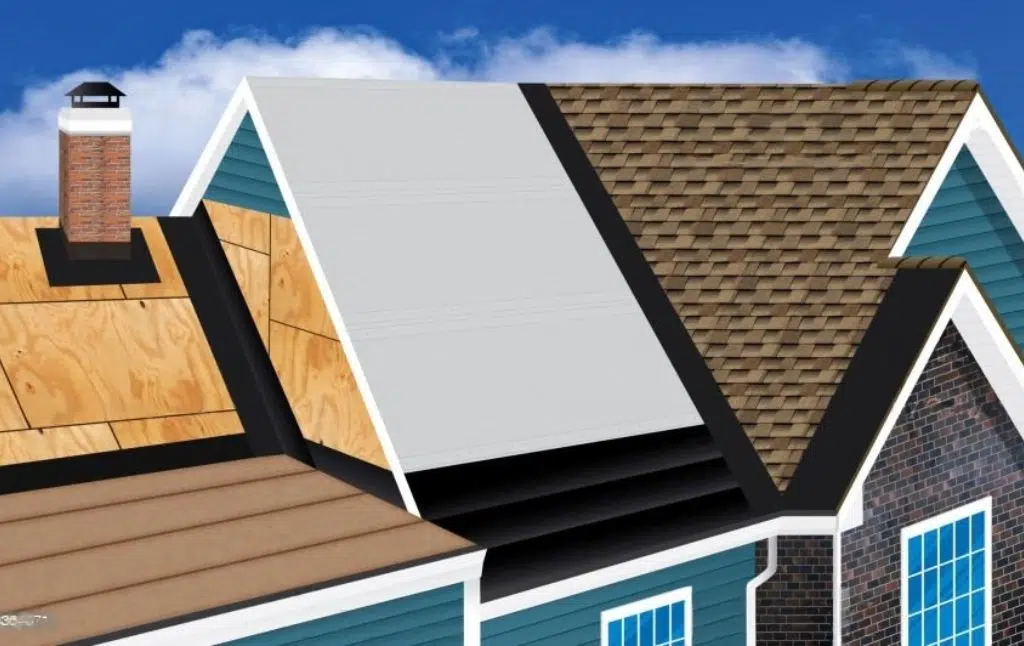
A roof is a layered system.
Depending on the assembly, components can include:
roof covering
↓
underlayment / weather protection
↓
roof sheathing
↓
framing
↓
insulation / air-control strategy
↓
interior ceiling
Other critical elements intersect these layers:
- flashing;
- vents;
- skylights;
- chimneys;
- gutters.
CHC Project Insight
When homeowners compare roof proposals, focusing only on the shingle or panel brand can hide important scope differences.
A useful proposal should make clear what happens to:
- existing covering;
- sheathing;
- underlayment;
- flashing;
- ventilation;
- penetrations;
- damaged substrate discovered during tear-off.
For projects that connect roofing decisions with broader structural or interior work, review CHC Remodeling’s whole-home remodeling services.
21. When Should You Replace a Roof in Kirkland?
There is no responsible universal answer such as:
“Every Kirkland roof should be replaced at 20 years.”
Replacement timing should consider condition + repairability + risk.
A professional inspection becomes more important when several of these conditions appear together:
- repeated leaks;
- leaks in multiple areas;
- widespread damaged or missing roof covering;
- extensive granule loss or deterioration on asphalt shingles;
- widespread failed flashing;
- deteriorated roof deck;
- persistent moisture damage;
- recurring repairs across several roof areas;
- material damage that cannot be repaired reliably;
- aging roof plus increasing failure frequency.
Direct Answer
Age should trigger questions—not automatically replacement.
22. Repair vs. Replacement: Use the Pattern of Failure
Consider two examples.
Scenario A: Localized Problem
The roof is generally performing well, but one flashing location develops a problem.
If surrounding materials remain serviceable, a localized repair may make sense.
Scenario B: Distributed Failure
The roof has:
- several leak locations;
- widespread material deterioration;
- recurring flashing failures;
- deteriorated sheathing in multiple areas.
Replacing one component may no longer solve the underlying system-level problem.
Decision Principle
One defect can often be a repair problem.
A repeating pattern across the roof can become a replacement problem.
23. Roof Replacement Timing Guide
| Condition | More Likely Next Step |
|---|---|
| One isolated damaged area | Investigate repair |
| Local flashing problem | Repair may be appropriate |
| Small amount of growth, roof otherwise sound | Material-appropriate maintenance/inspection |
| Debris-filled valley | Clear and inspect |
| One historical leak with known cause | Verify repair |
| Repeated leaks in different areas | Broader roof evaluation |
| Widespread shingle deterioration | Evaluate replacement |
| Multiple active flashing failures | Evaluate system condition |
| Soft/damaged sheathing discovered | Determine repair/replacement scope |
| Widespread material failure | Replacement becomes more likely |
| Old roof but still performing | Inspect; age alone does not decide |
| Newer roof leaking | Diagnose installation/detail problem |
This table is a homeowner decision framework, not an inspection report.
24. What About Granule Loss on Asphalt Shingles?
Granules are part of the shingle surface.
Finding a few loose granules does not automatically diagnose roof failure.
The useful questions are:
- Is granule loss widespread?
- Are bare areas developing?
- Is deterioration concentrated in drainage paths?
- Are shingles cracking, lifting or otherwise damaged?
- Are leaks also occurring?
Inspection Principle
Evaluate patterns, not isolated symptoms.
25. Ceiling Stains Don’t Automatically Tell You Where the Roof Failed
Water can travel.
A ceiling stain may not sit directly below the exterior entry point.
Water can move along:
- framing;
- sheathing;
- pipes;
- other building components.
Condensation can also produce moisture symptoms that resemble leaks.
That is why diagnosing from the interior stain alone can lead to the wrong repair.
Better Question
Where is the moisture entering or forming?
Not simply:
“Where is the stain?”
26. Sagging or Soft Areas Need More Attention Than Cosmetic Aging
A faded shingle color is different from a structural roof-deck concern.
If there are signs suggesting:
- sagging;
- soft sheathing;
- significant structural deformation;
the issue deserves prompt professional investigation.
The City of Kirkland specifically distinguishes simple like-in-kind reroofing from work involving structural elements such as roof sheathing. Structural roof work changes the permitting and construction scope. (Kirkland)
27. Replacement Timing Should Include the Roof Deck
One of the most useful moments in a roof replacement is when the existing covering is removed.
That exposes the roof deck.
The deck can then be evaluated for conditions that were difficult to see beforehand.
Possible findings can affect:
- sheathing replacement;
- flashing work;
- ventilation details;
- overall scope.
Planning Question Before Signing
Ask:
How will deteriorated sheathing discovered during tear-off be documented, priced and approved?
This prevents a predictable hidden-condition issue from becoming an undefined change later.
28. Don’t Wait for an Active Interior Leak to Start Planning
A roof does not need to be actively dripping into the living room before you evaluate its condition.
Planning earlier gives you more opportunity to:
- compare materials;
- inspect ventilation;
- evaluate sheathing assumptions;
- understand permits;
- review warranties;
- schedule work;
- compare complete proposals.
Better Replacement Strategy
Plan from condition trends rather than emergency failure.
That does not mean replacing a functioning roof prematurely.
It means knowing what you own.
29. The Best Season to Replace a Kirkland Roof Is Not One Fixed Month
Homeowners often ask:
“Do roofs have to be replaced in summer?”
The better answer is:
Installation conditions need to meet the requirements of the roofing system being installed.
Different products have manufacturer-specific requirements involving:
- temperature;
- moisture;
- sealant;
- fastening;
- underlayment;
- safe working conditions.
Therefore, avoid publishing a universal rule such as:
“Only replace your roof between June and September.”
Planning Advantage
If replacement is foreseeable rather than an emergency, you have more flexibility to coordinate an appropriate installation window.
30. Does a Kirkland Reroof Require a Permit?
Sometimes.
The City of Kirkland currently identifies like-in-kind reroofing of one- and two-family dwellings as permit-exempt when roof sheathing is not removed or replaced. (Kirkland)
Kirkland identifies reroof work involving structural elements—such as:
- sheathing;
- skylights;
- mechanical equipment;
as work that can require permitting. (Kirkland)
The City’s current permit-review guidance also identifies qualifying straightforward reroof projects separately from work involving structural modifications, roof-height changes, skylight changes, rooftop equipment or roof-top insulation changes. (Kirkland)
Direct Answer
Do not ask only:
“Does reroofing need a permit in Kirkland?”
Ask:
“What exactly are we changing as part of this reroof?”
For nearby remodeling and construction planning, see CHC Remodeling’s Kirkland home remodeling services.
31. A Skylight Can Change More Than the Roofing Material
If you’re replacing the roof and also changing skylights, coordinate those decisions.
A skylight creates:
- an opening;
- flashing;
- water-management details;
- interior implications.
Kirkland specifically distinguishes simple reroof work from reroofing that includes skylight additions or relocation for permit-processing purposes. (Kirkland)
Planning Rule
If a skylight is nearing replacement or you want to change its size/location, evaluate it before the new roof is installed.
32. Roof Ventilation Should Be Evaluated During Replacement
Roof replacement is a useful opportunity to inspect:
- existing soffit/intake vents;
- ridge or exhaust ventilation;
- blocked airflow paths;
- insulation around eaves;
- existing roof penetrations;
- roof-deck condition.
But that does not mean every reroof requires changing the ventilation system.
Better Approach
Ask:
What ventilation strategy does this house currently use, and is it functioning as intended?
Then determine whether modification is justified.
If rooftop equipment or future solar work affects the scope, coordinate the plan with qualified Seattle electrical services.
33. Don’t Confuse Roof Ventilation With Bathroom Ventilation
They solve different problems.
Roof/attic ventilation manages the roof or attic assembly.
Bathroom ventilation removes moisture generated by the bathroom.
A homeowner may have a new ridge vent and still have an indoor-moisture problem if moisture is being introduced into the roof assembly from elsewhere.
Think of moisture control as a whole-building problem, not only a roof accessory problem.
34. Trees Are Both an Asset and a Roofing Maintenance Variable
Trees can provide:
- shade;
- privacy;
- landscape value.
They can also contribute:
- leaves;
- needles;
- branches;
- reduced drying time.
The correct answer is not automatically:
“Remove all trees near the house.”
Instead ask:
- Are branches physically contacting the roof?
- Is debris accumulating heavily?
- Can gutters be maintained?
- Can critical roof surfaces dry?
- Can maintenance be performed safely?
Better Goal
Manage the interaction between roof + trees, rather than treating one as automatically incompatible with the other.
35. Compare Roofing Proposals as Systems
If replacement becomes necessary, do not compare only:
Contractor A: $X
Contractor B: $Y
Normalize the scope.
Ask what each proposal includes for:
| Component | What to Compare |
|---|---|
| Tear-off | Number/types of existing layers addressed |
| Roof deck | Inspection and damaged-sheathing process |
| Underlayment | Exact system/specification |
| Roofing material | Manufacturer, line and specification |
| Flashing | What is replaced vs. reused |
| Valleys | Proposed system/details |
| Ventilation | Existing strategy and proposed changes |
| Penetrations | Pipe boots, vents, skylights |
| Gutters | Included or separate |
| Cleanup | Debris/site protection |
| Warranty | Product and workmanship terms |
| Change orders | How hidden conditions are priced |
CHC Project Insight
This is why comparing “price per roof” without normalizing the scope can be misleading.
Two proposals using the same visible shingle may represent very different roof systems.
36. Ask These 10 Questions Before Choosing a Replacement Roof
1. What specifically is failing on the existing roof?
Avoid replacing a roof without understanding the problem.
2. Is the problem localized or widespread?
This helps frame repair versus replacement.
3. What condition is the roof deck expected to be in?
Ask how concealed damage will be handled.
4. Is this material appropriate for my roof slope?
Product selection should follow geometry.
5. How does my shade and tree exposure affect the material?
Site conditions matter.
6. What is the current attic/roof ventilation strategy?
Do not assume more vents are automatically required.
7. What flashing will be replaced?
Clarify valleys, penetrations, walls and skylights.
8. Does this project require a Kirkland permit?
Base the answer on the actual scope.
9. What maintenance does the selected roof require?
Ask before installation.
10. What does the warranty actually cover?
Read coverage, limitations and owner responsibilities rather than relying on the headline duration.
37. A Simple Kirkland Roof Monitoring Plan
Homeowners do not need to climb onto the roof to monitor it.
From safe locations, periodically pay attention to:
- visible missing/damaged roofing;
- heavy moss growth;
- debris-filled valleys;
- clogged gutters;
- overflowing gutters;
- damaged flashing visible from safe locations;
- interior ceiling staining;
- unusual attic moisture;
- signs of sagging.
After significant weather, pay attention to changes rather than assuming everything is unchanged.
Professional Inspection Makes More Sense When
- symptoms are new;
- leaks repeat;
- several problems appear together;
- the roof is difficult to evaluate safely;
- you are approaching a major repair/replacement decision.
38. Common Kirkland Roofing Mistakes
Replacing a Roof Because an Online Lifespan Chart Says So
Age is one data point, not the entire diagnosis.
Waiting for Water to Reach the Ceiling
Planning can start before emergency failure.
Choosing Roofing by Material Name Alone
“Metal,” “asphalt,” and “cedar” each describe broad product categories.
Ignoring Roof Slope
Material and slope need to be compatible.
Treating Moss as Purely Cosmetic
Heavy growth can affect water movement and drying.
Treating Every Dark Stain as Moss
Organic roof growth is not all identical.
Pressure-Washing Every Roof
Cleaning methods should match the roof material and condition.
Adding Exhaust Vents Without Intake
Ventilation needs to work as a system.
Assuming Every Roof Must Have Ridge Vents
Properly designed unvented assemblies also exist.
Ignoring Attic Moisture
Some roof symptoms begin from inside the building.
Looking Only at Shingles
Flashing, underlayment, sheathing and ventilation matter.
Ignoring Trees and Shade
Exposure can vary dramatically by roof slope.
Assuming a Like-for-Like Reroof and Structural Reroof Have the Same Permit Requirements
Kirkland distinguishes between them. (Kirkland)
Kirkland Roof Material Decision Table
| If Your Priority / Condition Is… | Evaluate First |
|---|---|
| Familiar steep-slope residential system | Architectural asphalt options |
| Longer-term manufactured roof system | Standing-seam/other appropriate metal options |
| Natural traditional appearance | Cedar, with maintenance/drying requirements understood |
| Low-slope roof section | Appropriate membrane/system |
| Heavy shade and trees | Debris/moss maintenance implications |
| Complex roof with many valleys | Water-management details |
| Multiple skylights | Flashing and penetration strategy |
| Cathedral ceiling | Roof-assembly/ventilation design |
| Existing attic moisture | Diagnose moisture source before reroof |
| Repeated leaks | Determine whether failures are localized or distributed |
| Future solar | Coordinate roof condition and remaining serviceability first |
This table identifies what to investigate, not one universally best material.
KIRKLAND HOMEOWNER QUESTIONS
Kirkland Roofing FAQ
Clear answers about wet-climate roof materials, moss, ventilation, repairability, replacement timing and Kirkland permit requirements.
What is the best roofing material for Kirkland’s wet climate?
There is no universal best roofing material.
Material selection should consider:
- roof slope;
- architecture;
- tree cover;
- shade;
- maintenance preferences;
- existing roof assembly;
- budget;
- expected ownership period.
Asphalt, properly designed metal systems, cedar and low-slope membrane systems can all serve appropriate applications. The roof system and installation matter alongside the material.
Does Kirkland rain shorten roof life?
Rain alone does not determine roof life.
More useful variables include:
- drainage;
- drying;
- tree debris;
- moss;
- flashing;
- workmanship;
- roof slope;
- ventilation/roof-assembly design;
- maintenance.
King County is classified as marine Climate Zone 4C, so moisture management deserves special consideration. (Washington State Legislature)
Does moss mean I need a new roof?
No.
Moss means the roof needs attention.
The appropriate response depends on the roofing material, amount of growth, underlying condition and whether physical damage has occurred.
For cedar roofs specifically, industry guidance warns that heavy moss can retain moisture and interfere with drainage. (Cedar Shake and Shingle Bureau)
Should I pressure-wash moss off my roof?
Do not apply one cleaning method to every roof.
Cleaning recommendations differ by material and manufacturer. Aggressive cleaning can damage certain roof coverings.
Have the material and condition identified first.
How important is attic ventilation in Kirkland?
Very important when the roof assembly is designed as a vented attic or vented rafter system.
Applicable code provisions require ventilation for these assemblies, while also allowing correctly designed unvented roof assemblies under specific conditions. (ICC Codes)
The important question is whether the home’s intended moisture-management strategy is working.
Is a ridge vent enough?
Not necessarily.
A ridge vent is an exhaust component.
Balanced ventilation generally requires adequate intake as well. Roofing manufacturers such as GAF and Owens Corning specifically emphasize coordinated intake and exhaust. (GAF)
How old should a roof be before I replace it?
There is no universal replacement age.
Consider:
- material condition;
- leak history;
- flashing condition;
- roof deck;
- repair history;
- ventilation;
- remaining repairability.
An older functioning roof may warrant monitoring.
A newer poorly performing roof may need significant corrective work.
Is a metal roof better than shingles for Kirkland?
Not automatically.
Metal can offer strong water-shedding characteristics, while asphalt systems provide a familiar and repairable residential option.
The better choice depends on:
- roof design;
- product specification;
- budget;
- architecture;
- maintenance;
- installation quality.
Avoid choosing solely from material-category claims.
Is cedar roofing suitable for Kirkland?
It can be, but cedar requires a deliberate installation, ventilation/drying and maintenance strategy.
The Cedar Shake & Shingle Bureau emphasizes that debris should be removed and that cedar needs opportunities to breathe and dry. (Cedar Shake and Shingle Bureau)
Does reroofing require a Kirkland permit?
It depends on the scope.
Kirkland currently exempts qualifying like-in-kind reroofing of one- and two-family dwellings when roof sheathing is not removed or replaced. Work involving structural elements such as sheathing, skylights or mechanical equipment can require permitting. (Kirkland)
Does replacing roof sheathing change the permit situation?
Yes, it can.
Kirkland specifically identifies reroof work involving structural elements such as sheathing separately from permit-exempt qualifying like-in-kind reroofing. (Kirkland)
Should I replace skylights when replacing the roof?
It deserves evaluation.
Consider:
- skylight condition;
- flashing;
- age;
- desired size/location;
- expected remaining serviceability.
Changing or relocating skylights can also affect Kirkland’s reroof permit path. (Kirkland)
Is summer the only good time to replace a roof in Kirkland?
No universal month applies to every roof product.
Installation conditions need to satisfy the selected system’s manufacturer requirements and safe construction practices.
Planning before an emergency gives you more flexibility to coordinate an appropriate work window.
MAKE THE ROOF DECISION FROM EVIDENCE
Bottom Line: Kirkland’s Climate Changes the Questions—Not the Fundamentals
The wrong way to evaluate a Kirkland roof is:
roof age → generic lifespan chart → automatic replacement
The better process is:
roof geometry → exposure → drainage → material → flashing → ventilation → condition → repairability → replacement decision
Kirkland’s wet marine climate means homeowners should pay particular attention to:
- roof sections that stay shaded;
- moss and debris;
- valleys;
- gutters;
- penetrations and flashing;
- roof-deck moisture;
- attic/roof-assembly ventilation;
- material-specific maintenance.
But wet weather does not make every roofing material fail on the same schedule.
Replace When the System Tells You To
Replacement becomes more compelling when the roof shows a widespread pattern of deterioration or repeated failure that can no longer be addressed reliably with localized repair.
Repair may remain sensible when the problem is specific, identifiable and surrounded by otherwise serviceable roofing.
And age?
Use it as context.
Not as the diagnosis.
If an inspection shows that the roof has moved beyond maintenance or localized repair and a full roofing scope is warranted, review CHC Remodeling’s roof replacement and roofing services for the construction side of the project.
Turn roof conditions into a defined scope.
If inspection shows that repair is no longer reliable, compare materials, flashing, sheathing, ventilation, permitting and construction sequencing as one coordinated system.